
Jersey City Resident Lookup Records and Scope
There is no single official roster of Jersey City residents. Each official system answers a limited question, so the strongest resident lookup starts by naming that question. A parcel result can supply a property key and an assessed owner lead. A court result can identify a party and docket. A vital-record route concerns an event, while a voter result concerns registration status. None should be relabeled as proof of current occupancy without evidence that actually says so.
| Record | What It Confirms | Where | Access |
|---|---|---|---|
| Assessment or parcel record | Block/lot, location, assessment context, and owner-name lead | TaxRecords-NJ after selecting Hudson County and Jersey City | Online, then the Jersey City Assessor for clarification |
| Recorded instrument | Grantor, grantee, legal description, date, and document reference | Hudson County Register Acclaim | Online index and Register search area |
| Court case metadata | Party, venue, docket, caption, initiation date, and status where supplied | NJ Courts Find a Case | Division-specific online search and court request routes |
| Vital event | Official route for birth, marriage, death, civil union, or partnership record | New Jersey Department of Health, City Clerk, or State Archives | Eligibility, ID, and date rules apply |
| Voter status | Registration status when the official tool returns a match | NJ statewide status lookup | Registrant route; lists have statutory limits |
For a property question, start with the situs address and block/lot. For a court matter, a docket or complaint is safer than a broad name search. For a historical person, preserve the name, year, and publication or archive source. The key is to keep owner, party, voter, agent, and historical-directory labels separate rather than collapsing them into “resident.”
Jersey City: How to Look Up a Resident
A well-scoped name search uses the least-sensitive key that answers the purpose. The City Assessor directs property researchers to TaxRecords-NJ, where property location, owner name, or block and lot can be used after choosing the county and municipality. The Hudson County Register is the next stop for a recorded instrument, because Acclaim supports party name, book/page, instrument number, legal description, document type, consideration, and record-date searches.
Address labels need care. A parcel's situs is the physical location, but an owner or deed party may have a different correspondence address. A trustee, lender, estate, or entity can appear in the index as a lawful role without being the occupant. Record the source label, source date, and query key alongside any result. This approach also makes a spelling correction or a later recheck possible.
Jersey City Court Fields to Look Up a Resident
The state court system is useful for case metadata, not a general address directory. The public case-jacket guide offers search by docket number and search by party name. For an individual, it calls for last and first name, with middle initial optional, and distinguishes individual from business searching. Its result view identifies Name, Venue, Docket Number, Case Caption, and Case Initiation Date. A case hit therefore deserves a role, division, and status check before it is cited.
| Result element | Why it matters | What it cannot establish |
|---|---|---|
| Party name and caption | Shows the name's role in a particular case | That every similar name is the same person |
| Venue and docket | Identifies the selected court system and case reference | A current Jersey City address |
| Initiation date and status | Places the metadata in time and shows the displayed case state | All filings, final outcome, or a complete history |
Hudson Vicinage is at 595 Newark Avenue, with the William J. Brennan Jr. Courthouse at 583 Newark Avenue. The main Hudson Vicinage number is (201) 748-4400, and the Criminal Records Room at 595 Newark Avenue is Suite 104, (201) 217-5216. Closed or archived matters use the statewide court-copy process and may route through the Superior Court Clerk. Municipal matters are narrower still: Jersey City Municipal Court uses NJMCDirect by ticket or complaint information, and its call center is (201) 209-6700.
Jersey City Voter Status Has Its Own Limits
The official registration-status link is intended for the registrant. During research, the endpoint returned an access denial, so exact live prompts and result wording are not assumed here. The New Jersey registration guidance explains that inactive status reflects an address-confirmation process, often when a sample ballot is returned undeliverable. It is not a finding that someone abandoned an address or is not a Jersey City resident.
The state registration-status route remains the appropriate official starting point. For list or district questions, Hudson County Board of Elections and the County Clerk are the named channels. N.J.S.A. 19:31-18.1 permits voter-list copies on request at $0.25 per copy of a list of voters per election district and places use restrictions on those copies. Original registration forms, signatures, ID numbers, and bulk data do not belong in a public lookup.
A captured view of the state registration-status lookup documents the official route, while the research gap on the live endpoint remains important. It should be treated as a route card rather than a promise of searchable fields.
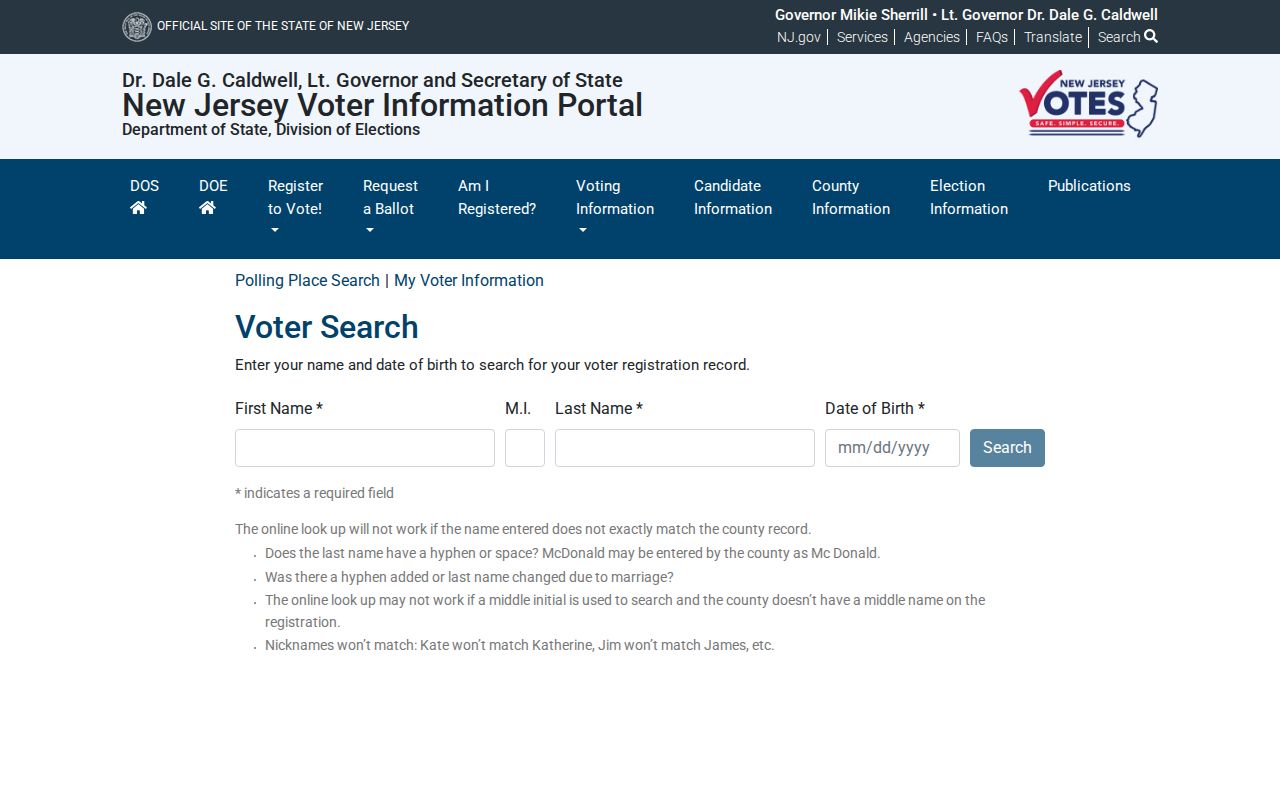
The status tool can support an individual's registration check, but it does not turn a status result into proof of present residence or permission to republish voter information.
Verifying a Jersey City Resident Record Across Sources
Same-name matches are common in a dense city and across Hudson County. A second independent source should test the role, date, address label, and jurisdiction before a research note treats two entries as connected. This sequence is especially useful when an initial search gives only a name and a court or property clue.
- Define the purpose and write down the least-sensitive known key, such as a parcel address, block/lot, docket, or historical year.
- Use the responsible official system and preserve the exact query, result role, source date, and any coverage limitation.
- Compare a second source that answers a different question, such as an assessor parcel and recorded instrument, or a directory entry and newspaper page image.
- Check redactions, access rules, spelling variants, and date conflicts before asking the next custodian for a permissible copy.
- Docket
- A court's identifying number for a case, used with the court division and venue to locate the right matter.
- Index versus image
- An index supplies searchable metadata; the underlying document image may have separate access, redaction, fee, or browser requirements.
- Certified copy
- A copy issued or certified by the responsible custodian when the requester meets that record's applicable access rules.
Jersey City Vital-Record Windows for a Name Search
Vital records document events, not a standing address. New Jersey treats births within 80 years, marriages within 50 years, deaths within 40 years, and all domestic partnerships or civil unions as current non-genealogical categories. Eligibility, relationship or authority, acceptable ID, and the record's event location still matter. The state asks for details such as the full name on the record, event city, exact date, and parental or spouse information when applicable.
The Department of Health lists a $25 initial search that includes one certified copy, certification, or no-record result, with $2 for each additional copy of the same record. Mail applications use a check or money order as directed, not cash. For an event in Jersey City, the City Clerk is the local registrar route; marriage-certificate copies are available by mail or in-person appointment under the clerk's guidance. Older research can move to the State Archives or the JCFPL New Jersey Room rather than assuming current certification rules apply.
The New Jersey vital-record ordering page sets out the state route, identification, and support-document context for an eligible request.
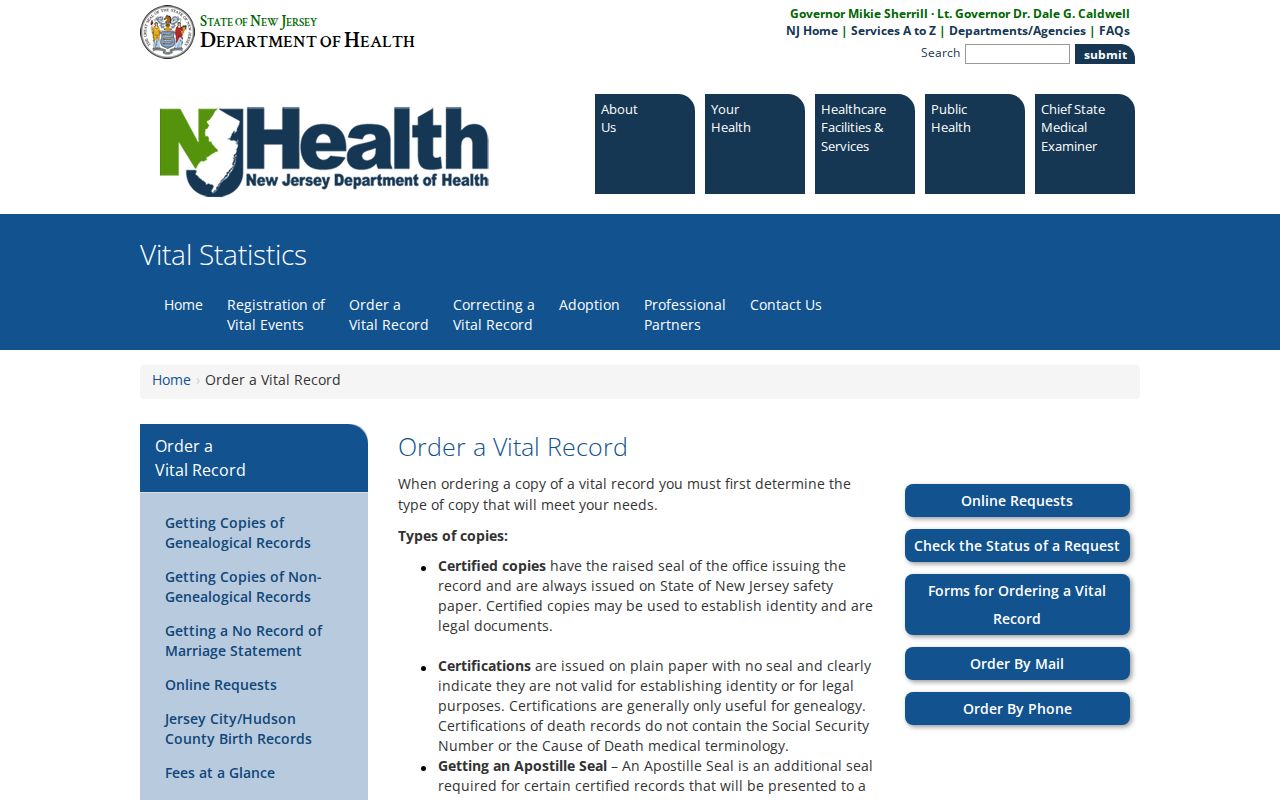
Using the event city and exact date helps distinguish similarly named people, while the eligibility rules prevent a vital-event record from becoming an open resident list.
A Jersey City Resident Verification Card
A compact research card is an insider safeguard against overreading a name result. It preserves the trail without copying sensitive source material into a new directory. For each result, keep the official source, the exact query key, the source's role label, the record or source date, a currentness limitation, and the next custodian. For property, also keep whether an address is situs or mailing.
For example, an Acclaim entry should be noted as a recorded-instrument lead with party role, legal-description or instrument reference, and recording date. A court entry should carry its division, venue, docket, caption, party role, initiation date, and displayed status. A historical directory or obituary requires the publication year and page-image check. The card makes a no-result meaningful too: it identifies the searched system, spelling, date range, and coverage boundary rather than claiming that no person exists.
Jersey City Resident Research Privacy Limits
Access restrictions are part of the record, not a dead end to work around. New Jersey's Address Confidentiality Program uses substitute addresses for qualifying survivors and certain reproductive-health participants. Daniel's Law supports residential-address redaction for covered public-safety officials and their immediate household members. MVC personal information is constrained by DPPA rules, while court records, adoption materials, vital records, and voter data have their own gates. A missing address may reflect a lawful protection.
Lawful use. Use a Jersey City name search for personal, lawful research and stop when a source shows a confidentiality limit. Do not use a result to stalk, harass, intimidate, or harm anyone, and do not seek protected details through a different system.
When a Jersey City Resident Search Finds No Match
No match means only that the chosen system, query, and coverage did not return a result. The Hudson Register advises searching spelling variations, initials, punctuation, and entity-name forms. Court systems divide material by case type and may hide confidential information. A voter endpoint can be unavailable, a vital record can fall within an access limit, and an older index can be incomplete or use a different place label. Preserve the failed query before changing the search.
When a portal cannot supply the needed record, use the responsible fallback: call the Jersey City Assessor at (201) 547-5131 for an assessment question; call the Hudson County Register at (201) 395-4760 for recorded-document instructions; use the court's electronic or closed-case request route; contact the City Clerk, State Archives, or New Jersey Room for the right vital or historical channel. An OPRA request can seek a specific accessible government record from the named custodian, but it does not override a privacy statute or court rule.
Keep Public-Safety Systems Outside a Jersey City Name Search
New Jersey's incarcerated-person, parole, and special-purpose registry systems are not extensions of an ordinary name search. Their data is sensitive, dynamic, and governed by separate legal terms. No official Hudson County jail resident-name roster was located in the research. Court venue, a state custody record, or a specialized public-safety result should never be used to infer a current city address, danger, guilt, or a complete history.
Use the official agency route only when the record category itself is the question, retain the agency's limitations, and do not merge it with ordinary property, voter, historical, or vital research. That separation protects both the reader and the meaning of the records.