
Trace Previous Jersey City Residents
Previous residents research starts with the era, not a name. Jersey City has an unusually useful run of published city directories, a local newspaper index, Sanborn maps, county deed resources, and state archival collections. Each source records something different. The source below can identify a printed address association, a structure, a legal transfer, an event, or a family lead. It should not be read as one merged household list.
| Source | Years it covers | Where held | What it shows |
|---|---|---|---|
| Jersey City/Hoboken directories | 1849-1925 core; detailed run includes 1849-1910, 1915, 1918, 1922, and 1925 | JCFPL New Jersey Room | Printed name, address, occupation, and reverse-address clues. |
| Jersey Journal index | 1912-1954; 1969-present | JCFPL New Jersey Room | Obituary, event, business, and civic-news leads. |
| Sanborn maps | 1896; 1912-June 1950 examples; Black Tom 1916 | Library of Congress and JCFPL resources | Structure, use, block/house number, and dated physical context. |
| Hudson County deed microfilm | Through 1900 | New Jersey State Archives | Older recorded-deed and index trail. |
| Hudson Register Acclaim | Official online back-year not located | Hudson County Register | Recorded instruments by party, legal description, or instrument key. |
For an early address, start in the directory and map collections, then move to Archives microfilm if the date falls within its deed span. For a later title question, begin with the current parcel and Acclaim, then step backward until the online route or the legal description requires an archival handoff.
Jersey City Address Eras
Write the target year at the top of the research note. Jersey City’s directory core is 1849-1925, but the detailed volume pattern has gaps after 1910. A missing name in one volume can reflect a move, a spelling variation, a nearby number, a boarder, a publisher change, or the absence of that year. The Jersey Journal index has its own windows, while the 1896 and 1912-June 1950 Sanborn examples describe different moments in the physical block.
State Archives collections supply another set of dates. It identifies Hudson County deed microfilm through 1900 and holds historical vital and naturalization material with collection-specific cutoffs. Archive access is not a substitute for the Register, and the Register’s online back-year was not located in official source descriptions. Label any boundary rather than guessing where one system begins or ends.
Jersey City Deed Chain Steps
Recorded title is the strongest route for previous owners, not necessarily previous residents. Obtain the current parcel’s situs, municipality, block, lot, and qualifier from the assessor or GIS layer. Then use the legal-description or party mode in Hudson Acclaim. The legal description can remain useful when a street number or spelling has changed. Do not substitute a mailing address for the physical situs.
- Write down the current Jersey City situs and parcel identifiers from the assessor or GIS record.
- Search Acclaim by legal description, block/lot and municipality, or by the current party where appropriate.
- Open the record details and copy the instrument or book/page, recording date, legal description, party roles, consideration, and prior-deed reference.
- Search the earlier party and prior reference, then read related mortgages, releases, assignments, easements, and restrictions as separate instruments.
- When the trail reaches an older record, compare the legal-description language before assuming two records concern the same parcel.
- Grantor
- The party transferring an interest in a recorded instrument.
- Grantee
- The party receiving an interest. Neither role by itself identifies an occupant.
- Chain of title
- The sequence of recorded interests connected through instruments and prior references.
- Legal description
- The parcel description in the instrument, often more stable than a historic street number.
Acclaim for Past Residents
Acclaim has separate Official Records modes for Name, Book/Page, Instrument Number, Legal Description, Document Type, Consideration, and Record Date. Name searching should be repeated for variants, initials, punctuation, and an entity form when the record suggests one. The Register warns that online accuracy and reliability are not guaranteed, so an index hit needs the document detail and a source-date note.
The Hudson Acclaim search screen shows the documented modes that make an address-first deed trail possible.
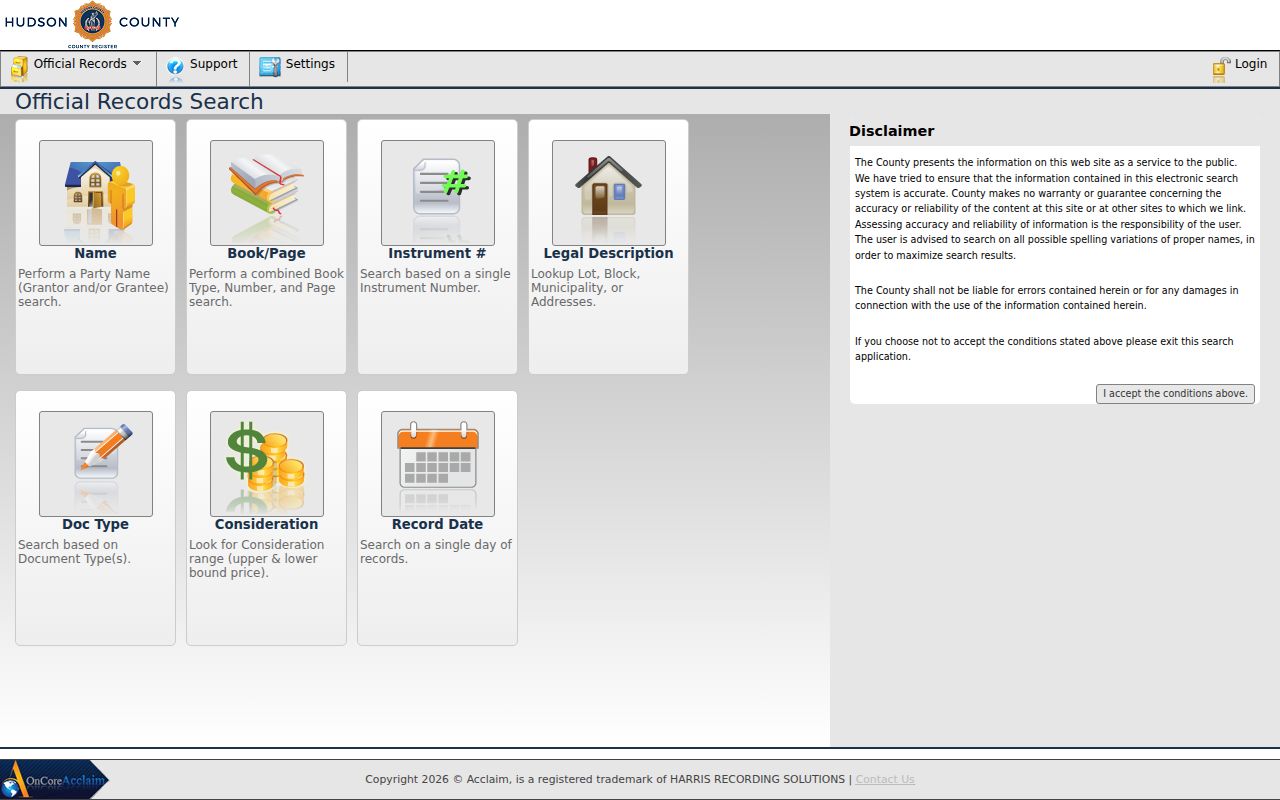
The screen is a search-method reference, not a result about a particular property. The Register’s office at 257 Cornelison Avenue, 2nd Floor, Jersey City, NJ 07302, also provides a search-area route; customer service lists (201) 395-4760.
Jersey City Directory Years
The New Jersey Room is the local shelf for the household side of a Jersey City address. Its holdings include complete published Jersey City/Hoboken city directories for 1849-1925, along with maps, photographs, manuscripts, vertical files, and Jersey Journal indexes. A direct directory entry can carry a printed name, occupation, street address, household role, business notation, or wording such as “removed” or “widow.” Keep the publisher’s wording intact.
A reverse or criss-cross entry moves from address to a printed name, then should be checked against the direct name entry in the same volume. Compare the next available edition and record year, title, page, and index type. The underlying volumes and entry conventions belong to the Jersey City city directory collections; the address trail uses them as one dated step.
Jersey City Sanborn Evidence
Sanborn and related fire-insurance maps explain the physical setting. Jersey City and Hudson examples include 1896, 1912-June 1950, and a Black Tom 1916 map. A sheet can show building size, construction, openings, use, house or block number, water mains, hydrants, fire boxes, and firewalls. Save the volume, sheet, year, and map key with the address form used by the map.
Follow the map with a Jersey Journal or digitized newspaper search for the address, surname, and business name. The Jersey City newspaper archive offers full-text browsing and date filters, but older OCR can misread names. Confirm an important hit on the page image and record the issue date and page. A map can show a store or row structure; it cannot identify everyone who lived there.
Jersey City Old Place Names
Older municipal labels are part of the address search. City historic-preservation material traces the consolidation of Hudson City, Bergen City, and Jersey City in 1869-70, with Greenville added in 1873. An older directory, map, or deed can use one of those earlier names. Search the historic label when the source predates consolidation, and cite the place exactly as printed before adding a clearly marked modern cross-reference.
This practice also helps with renumbered streets. Check block/lot, cross street, map sheet, and legal description instead of treating a near-numbered address as the same place. The safest conclusion is that records were associated with an address during a stated period.
Jersey City Household Trail
The household layer works as a dated flow: directory year and printed address, then map sheet and structure, then newspaper image and event, then recorded deed for title. Where a census source is appropriate to the target date, pair it with the directory year as household context and cite the collection separately. Do not use one source to fill another source’s gap.
A short research card is more useful than a long narrative: printed address; historical municipality; source title; year; page or sheet; party or entry role; record date; source URL; and uncertainty. This method keeps previous residents research reproducible when spelling, street form, or address numbering differs across documents.
Note: A historical directory entry is dated publisher evidence, not proof that a named person remained at the address after that edition.
Jersey City Historical Access Routes
Use the New Jersey Room for directories, maps, newspapers, and reference assistance. It lists hours Monday through Thursday from 9 a.m. to 8 p.m. and Friday and Saturday from 9 a.m. to 5 p.m., with confirmation recommended before visiting; its phone is (201) 547-4503. The State Archives is the route for its older collection and microfilm holdings. The Register is the route for title instruments and copies. These channels complement, rather than replace, the online indexes.
The room is also a FamilySearch Affiliate Library, so some restricted FamilySearch collections may be available within a branch to a visitor with a free account. That setting does not promise a particular Jersey City result or remote viewing. Ask a focused question with the address, the target year, and any older municipality name. For historic newspapers, save the publication title, issue date, page, and visible image after checking an OCR hit. Those details let a later reader distinguish a library finding from a recorded instrument.
For an unavailable, discrete county record, a custodian-specific request can identify the instrument, date range, or parcel. New Jersey OPRA is not a way around archival rules or privacy statutes. Its normal response timing is as soon as possible and no later than seven business days, subject to exceptions.
Limits on Previous Residents
Previous residents evidence has boundaries. A deed records an interest, not household occupancy. A directory can reflect a business, boarder, role, or printing convention. A Sanborn sheet depicts structure and use. An obituary or newspaper line can contain errors. The modern ArcGIS parcel layer reported a November 14, 2022 edit date, so it should orient a current parcel rather than backfill historical title or occupancy.
New Jersey privacy protections can lawfully limit a result. Keep unnecessary birth dates, signatures, identifiers, protected addresses, and sensitive details out of research notes intended for sharing. When a source does not support a claim, preserve the gap and use the responsible custodian.